The video model war is on.
Three serious contenders shipped within weeks of each other, each with a genuinely different philosophy of creation. We put all of them into production at Pletor and kept notes.
Here's the comparison, model by model, with a verdict for each and a decision table at the end.
Seedance 2.5: the director's model
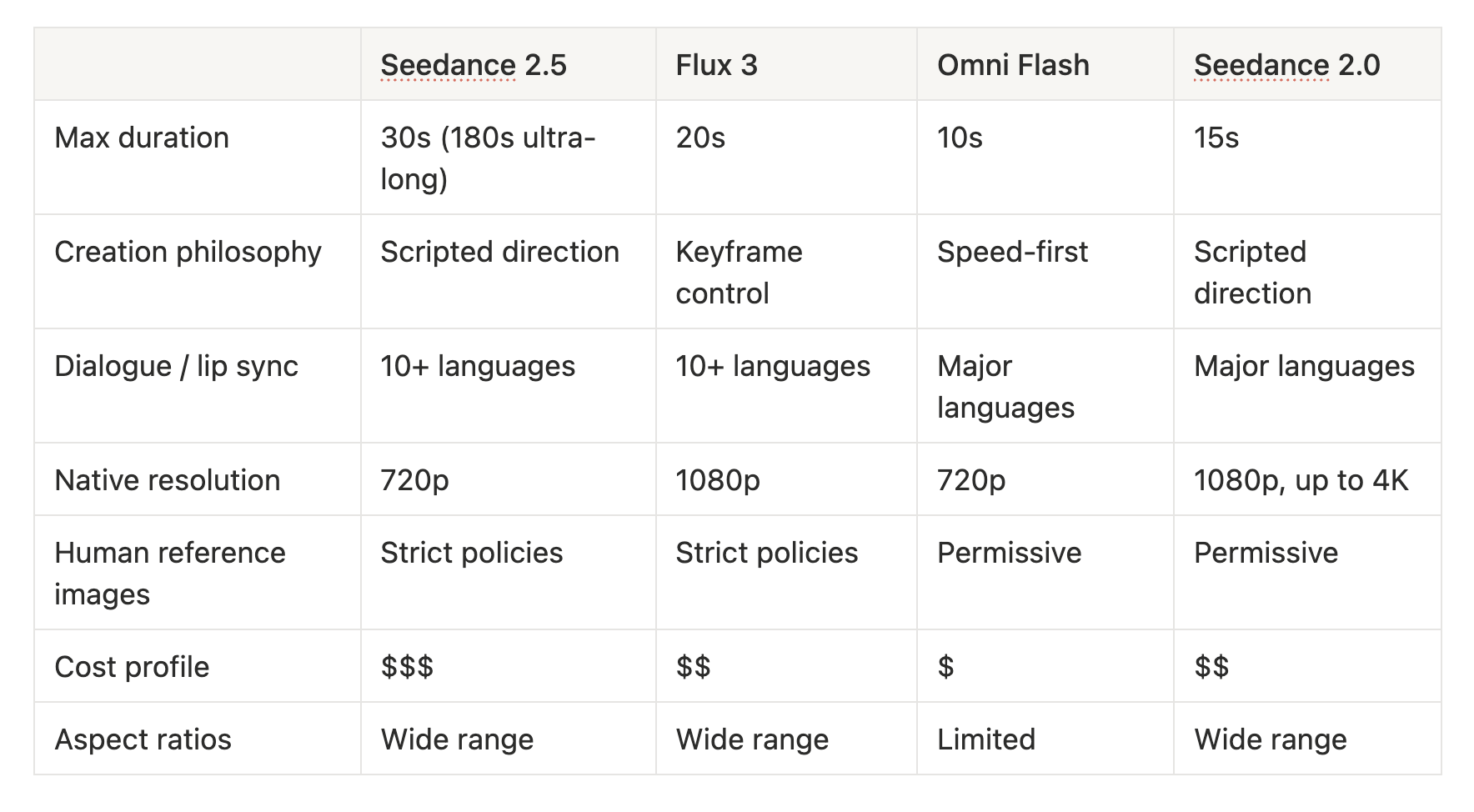
What it is. ByteDance's evolution of Seedance 2.0: double the duration ceiling, sharper realism, bolder camera moves, more languages, and negative prompts that actually hold.
What makes it different. Prompt accuracy on a level we haven't seen elsewhere. Write a timecoded script (beats, end states, transitions, delivery notes) and the model follows it, in one take. And the script adapts to the requested duration on its own: the same prompt at 30, 20, 12 and 8 seconds produced four complete versions of the same story, compressed rather than cut. One master script covers your TV cut, pre-roll and paid social asset.
Where it struggles. Content policies on reference images with people in them. Even harmless casting setups can get blocked. Text-described characters work around it; if your workflow depends on real faces from photos, this stings.
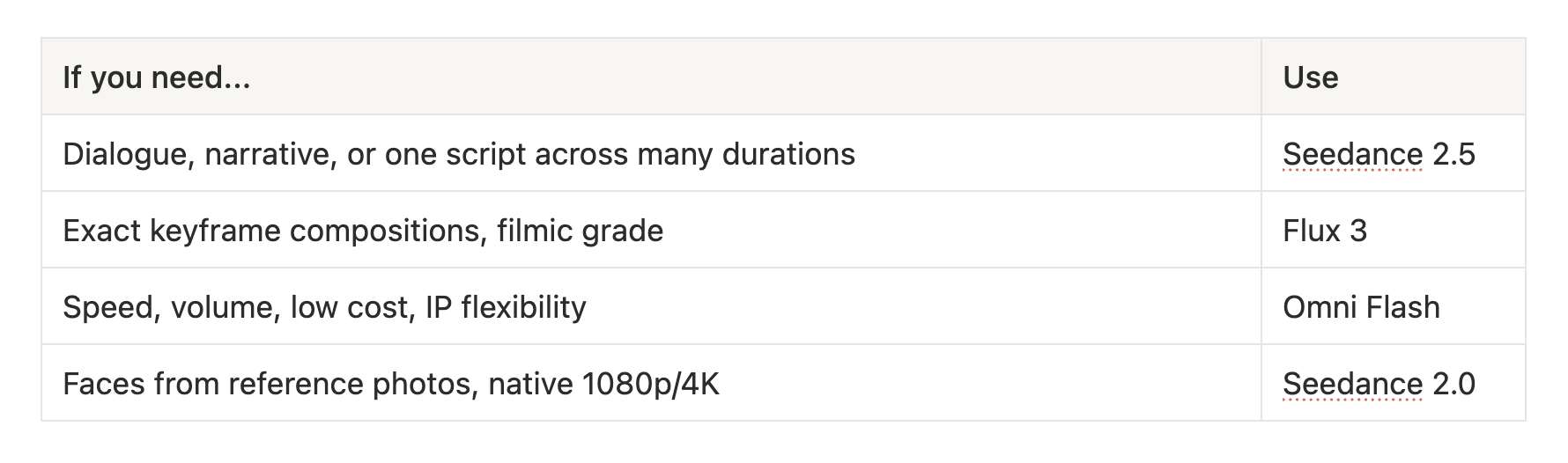
Verdict: the new default for anything with dialogue, narrative structure or multiple output formats. UGC, TV spots, stop-scrolling paid social.
Flux 3: the keyframe model
What it is. A different answer to the control problem. Seedance interpolates intermediary frames implicitly from your script; Flux 3 puts that capability in your hands. You place the keyframes, it builds the motion between them.
What makes it different. The strongest cinematic aesthetic of the group with minimal prompting effort, and frame-level precision when a shot must land on an exact composition.
Where it struggles. It caps at 20 seconds, and it's more erratic with precise prompts: it tends to tweak details you specified, especially dialogue lines. Direct it with frames, not with scripts.
Verdict: the pick for art-directed shots and filmic looks. Not the pick for dialogue-driven or long-form work.
Omni Flash: the volume model
What it is. The speed and cost play. Renders faster than everything else here, at a fraction of the price, and it's the most permissive with IPs.
Where it struggles. 10 seconds max, fewer aspect ratios, and video editing is where it spikes.
Verdict: the workhorse for high-volume iteration, concept exploration and IP-adjacent content. Graduate to Seedance 2.5 when a job needs duration or dialogue.
Seedance 2.0: not dead yet
Two reasons to keep it in rotation. It tolerates human reference images far better than 2.5, so face-driven image-to-video stays here for now. And it renders natively at 1080p and up to 4K, which 2.5 doesn't reach.
Don't keep it for price, though: 2.0 at 480p costs more per second than 2.5 at 720p.
Verdict: the specialist for character references and high-resolution delivery.
The decision table
Run them side by side
The real answer to "which model" is a routing decision per job, and it changes with every release. All four run on Pletor in the same workflow, so switching is a dropdown, not a migration.
Our agent compares them against your actual use case: click here to see more.

Ferdinand Terme
Founder & CEO @Pletor

Build your creative system.
Start free. Scale when you're ready.